When I saw last night that the government had decided to initiate a total lock down in England, Wales, and Scotland, I was so relieved. I felt like a stone had been taken off my chest, and I started to breathe more freely.
For a day or two I had been thinking of writing a post about my frustrations with the government’s lack of action, the blatant disregard of some of the public, and my fears that I would be stuck self-isolating for an extended amount of time, possibly until Christmas or longer. On Saturday pictures were posted of the packed beaches on the south coast near Brighton. I knew people who were going about their lives like normal, going shopping (not for necessities!), visiting friends. I was frustrated by the privilege people didn’t even realise they had: the privilege to minimise or disregard the risk, so that they could do what they wanted, because they are healthy, young, and strong.
It’s also been driving me nuts that people are talking about “showing symptoms” as an infection indicator, when it’s been made very clear that people can be infected and transmitting the infection for up to eleven days before feeling any symptoms. Here’s what I’m talking about:

What this graph shows is the time of infection versus the time of diagnosis. So, the yellow bars which peak to the right side are the number of cases and dates of confirmed COVID-19; the grey curve is the actual dates when the patients caught the virus. The difference, the parts of the grey which extend above the yellow, represent people who were walking around infecting the people whom they were around. That’s what makes this virus so hard to control: the long incubation period makes it an invisible enemy that we are chasing after.
The lockdown stops the virus in its tracks. There will be a surge after this, because there will be many people who have been infected but don’t know it yet. But as of last night, many of these people will be stuck at home, and will stop spreading the infection. (People who work at groceries, for the NHS, etc, are not so lucky, but we depend on them in this crisis, and we must recognise the risk they are subjected to; there is also an element of privilege, those who can work from home versus those who cannot, and those who were given no choice by their employers, but that’s for another post.) We are still on the ascent of this first big curve, but because of what happened last night, the downward slope towards normalcy and safety is that much closer.
It’s not realistic to think there won’t be future curves, but the first outbreak of an pandemic is usually the most severe. This is our biggest curve, and the government has finally helped us to shorten the curve (I’m avoiding “flatten the curve” because it’s not really a very accurate understanding). More curves will come, but they will be more like molehills to this mountain.
Of course, for this to really work, the lockdown must be enforced. In LA, we’ve been hearing reports that there is no enforcement of the shelter-in-place order, so the lockdown won’t be as effective. Today I see more people walking on the footpath outside my house, which does seem to indicate there are more people staying home today in my village. (I am pleased to report that they seem to be maintaining the two metre distancing.) I also got a text message from the government today:
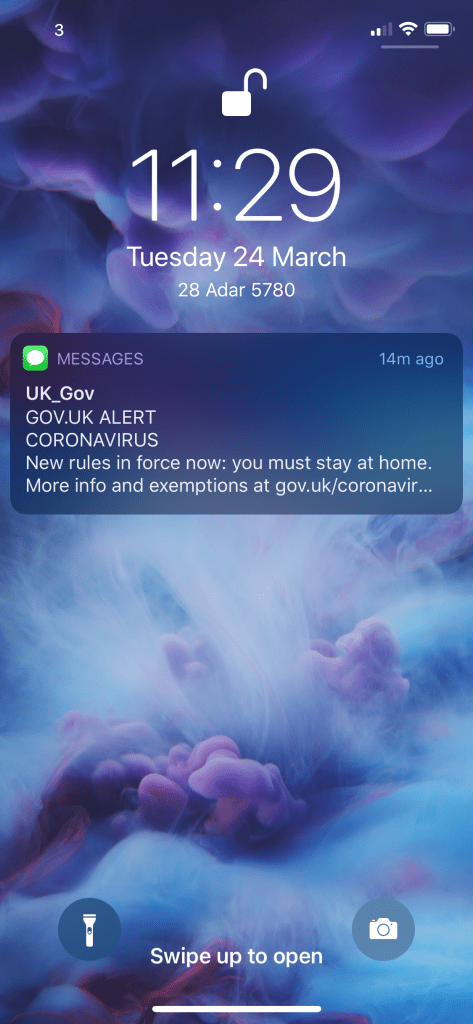
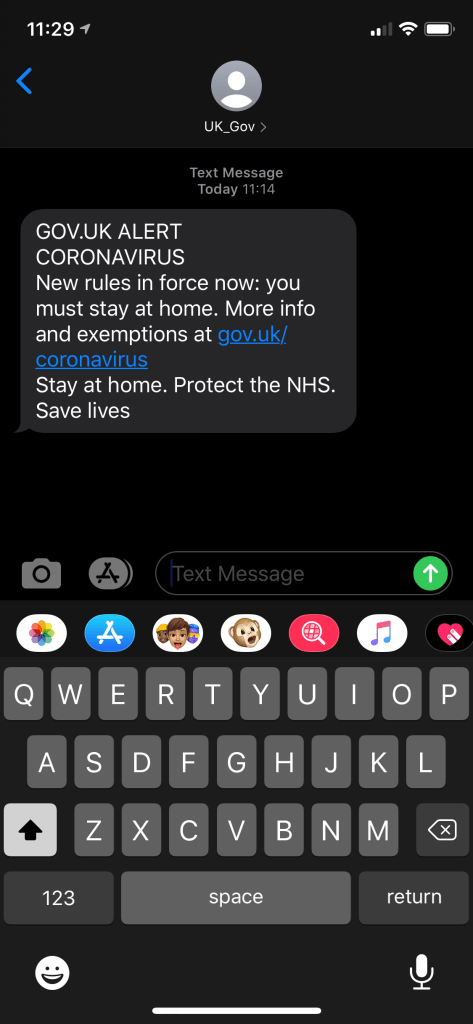
This indicates at least some dedication to enforcement of the lockdown order. We shall have to wait and see.
 This Isolation Life