*** This post has been edited from the original version. However, the substance remains the same.***
At first, it seemed simple. They were pulling names based on prescriptions, which meant I wasn’t sure they’d find me, so I went to the gov.uk website and filled in the form for people who think they fall in a high risk group.
About a week later, I got the following text from a 07 mobile number: [It reads: The NHS has identified you as at risk of severe illness if you catch coronavirus, as you either have chronic lung disease (interstitial lung disease) or have a suppressed immune system, and suggest that you SHIELD (stay at home for 12 weeks); see <link to government information website>]
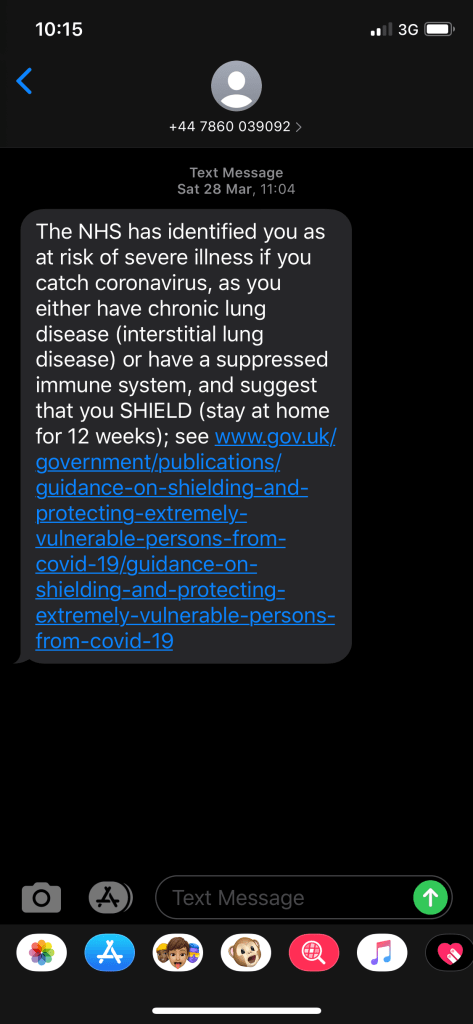
Great! I thought. All sorted, I’m on the list. That was easy!
I should have known it was too good to be true.
Two weeks after the initial text message, I then received first an email, then a text, both of which said the same thing, and both of which said the sender was GOVUK: [It reads: GOV.UK coronavirus support: You registered as clinically extremely vulnerable, but had not received a letter from the NHS to confirm this. We’ll share your details with the NHS. If the NHS defines you as clinically extremely vulnerable, the NHS will contact you. Your GP will be informed. If you told us you need help getting food and supplies, but you are not on the clinically extremely vulnerable list, we’ll share your details with supermarkets. They may be able to help. If you need support urgently, please contact your local authority. For the latest information, visit http://www.gov.uk/coronavirus%5D
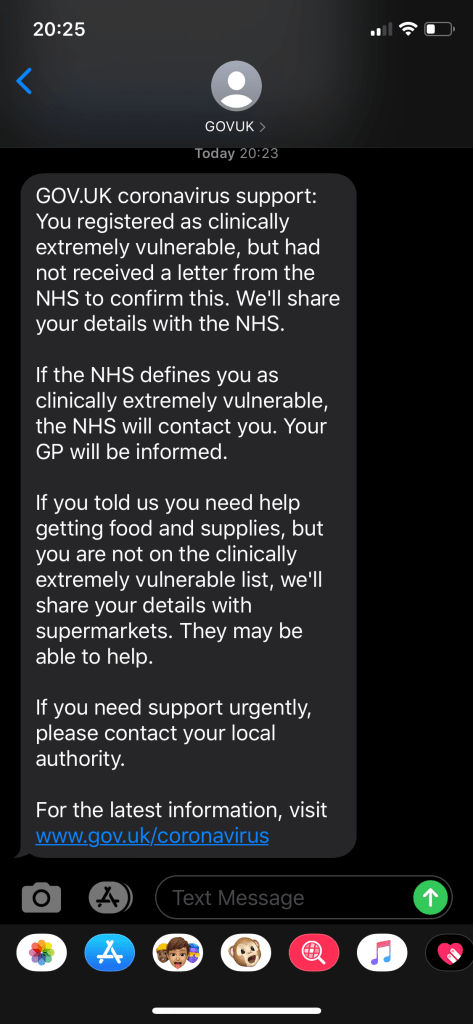
These two contacts made me confused, to say the least. It did clarify why I was having trouble getting the supermarkets to acknowledge that I was on the vulnerable list. Sainsbury’s later told me that they haven’t even received a list yet. At that point I’d been self-isolating for two days less than four weeks. I had other alternatives set up for food, some through luck, most through privilege, a few because of the kindness of friends and neighbours. What is someone who lacks my privilege and support network doing? I thought. How long is it going to take for this government response going to take to get organised?
Because I was concerned about A) having the access to the grocery deliveries if I ever desperately needed them, and B) making sure that the NHS and first responders knew that I’m high risk if I, G-d forbid, do catch this thing, I decided to email my GP and ask him if he knew what was going on, if he knew whether or not I was on the list, and, if I should be on the list, as I assumed I should, could he add me? I received a reply from my GP saying that he thought I should be high risk, and he didn’t have the ability to add me yet but thought he would be able to by Monday.
I have to say I love my GP. Just the fact that he’s happy to communicate with me over email is a plus. It’s such a relief to know that he’s got my back. Again, such a privilege. Many are not so lucky.
Today I received another email from my GP, reassuring me that he believes I have officially been added to the list as high risk, and I should appear on the list next time the system updates.
Hopefully this has worked. Now I am just waiting to see if I get any sort of confirmation from the greater NHS, or the government. I hope this means I’ll be given priority to make a Sainsbury’s delivery order at some point. It also, according to the letter, gives me the right to have my prescriptions delivered to my door (thankfully already happening due to the wonderful support network in my village), conduct hospital consultant appointments over phone or video chat, and evidently get some level of priority care if I ring 111 with symptoms.*
I worry, however, about those who don’t have the capacity for self-advocacy which I possess. How will they be added to this precious list? How will they get help if they lack a support system? Will their GP be attentive to adding their names, or fight for them the way mine has? I’m breathing somewhat easier today, because of the good news from the GP, but I won’t be totally happy until I receive word from the official government administration that I’m really on the list. How long will that take? How long for those less fortunate than myself? Readers, do make those you know who need the list aware of this story, and help them advocate for themselves to get through the system.
*In the UK, when one needs medical care from a specialist, this specialist is called a consultant, and maintains their office hours for patients in a hospital. Therefore, non-GP specialist appointments all take place at hospitals in the UK. 111 is a non-urgent phone number to call for medical advice in England, and usually it provides onward advice in terms of telling you to see your GP, advising you to go to Accident and Emergency (what we call the Emergency Room), or sends an ambulance. During the COVID-19 crisis, 111 is now dedicated to recording reports of symptoms, and if necessary, sending people to your home to assess you and take you to hospital if required.
 This Isolation Life